

Outlook Sharply Lower
Recent news has shown just how much pressure has built up on Volkswagen lately. While in July the company expected its operating margin to reach between 4 – 5.5 % this year, by mid-September it had significantly lowered its outlook to just 1 %, with revenue of around EUR 315 billion. However, the sharp deterioration in the forecast is not only due to a weaker underlying business. The result is expected to be burdened this year by approximately EUR 10 billion attributed to special effects, with as much as EUR 9 billion, according to Chief Financial Officer Arno Antlitz, falling in the second half of 2026. These effects include, for example, impairments of Porsche brand goodwill, the planned sale of a plant and others. Excluding these items, the margin would have reached approximately 4 %, according to Volkswagen.[1] Deutsche Bank points out that the 1 % margin alone does not provide a complete picture of the company’s condition, while at the same time highlighting the continuing problems in China and the high cost of restructuring.
Out of Europe’s Top Fifty
Shares reacted to the news with a decline, and another blow was Volkswagen’s removal from the Euro Stoxx 50 index, of which it had been a member for approximately 15 years. In the first half of the year, the company still generated revenue of EUR 158.1 billion and an operating profit of EUR 5.9 billion. The removal from the index occurred after a regular review, in which Volkswagen, due to the decline in its free-float market value, no longer met the conditions to remain in the index. As of September 21, 2026, the carmaker’s valuation was EUR 41.13 billion, while its shares on the Xetra exchange were at their lowest level since 2007, at a price of EUR 74.98.*
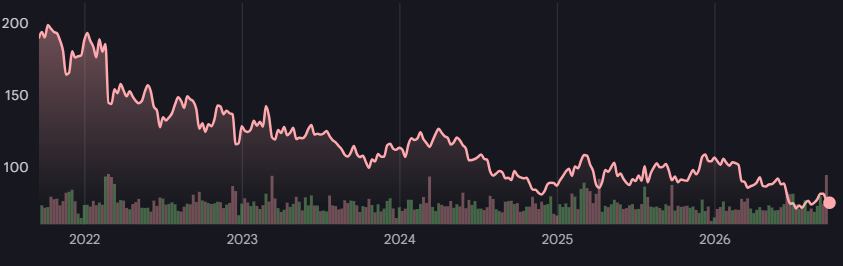
Source: Google Finance*
Losing Ground in China
Until recently, China was an important source of growth for the German carmaker, but domestic
manufacturers have gradually taken the lead. According to Volkswagen data, the
company delivered almost 26 % fewer vehicles in China in the first half of 2026 than a year earlier, while electric vehicle deliveries specifically fell by more than 47 %. The company also warned that the entire Chinese automotive sector weakened significantly in the first half of the year. While the group
delivered more vehicles outside China than a year earlier, weak development in its largest market pulled its global deliveries down by 6 %, and the company also warned that the negative market development was continuing. Reuters states that Volkswagen’s problems in the country began as early as 2024, when it lost its position as the largest carmaker and profits fell by more than 80 % over the past decade.
Porsche Is Losing Its Shine
Volkswagen’s situation is also being complicated by a brand that was supposed to generate profits for it, which were the main attraction of Porsche when it went public in 2022. However, the brand was hit by weakness in China’s luxury market, U.S. tariffs, while the change in product strategy also proved costly. The originally planned faster transition to electric mobility was once again replaced by combustion engines and plug-in hybrids, which required additional investment, pushing extraordinary expenses for 2025 to EUR 3.9 billion. The consequence is visible in profitability, with the operating margin falling to 1.1 % last year from just over 14 % in 2024. Porsche management, however, remains optimistic, and in its March report estimated a return on sales of 5.5 to 7.5 % for this year, with revenue of up to EUR 36 billion. [2] For Volkswagen as the majority owner, it is therefore important not only how many cars Porsche sells, but whether the brand can once again move closer to profitability.
Restructuring Is Gathering Pace
The giant is trying to address its problems through restructuring, but management indicates that it needs to accelerate, as high costs and competition from Asian manufacturers remain significant problems. The group needs to reduce the high costs of European production while continuing to invest in electric mobility and new technologies. The changes will include further layoffs, reductions in
production capacity and changes to the model line-up. On the other hand, Škoda, for example, is performing well, selling 8 % more cars year-on-year in the first half of the year, while the entire Brand Group Core increased operating profit by 4.5 %. Alongside the cuts, however, Volkswagen also needs to address its future growth, and electric mobility could be one of the areas. It is doing well in this respect in Europe and demand for electric vehicles is growing, while it is expanding its range with more affordable cars. However, growing sales will matter to investors if they gradually translate into higher profitability. Volkswagen therefore needs to fix its problems while also building a business that can replace them in the future.
* Past performance is not a guarantee of future results.
[1,2] Forward-looking statements are based on assumptions and current expectations that may be inaccurate, or on the current economic environment, which may change. Such statements are not a guarantee of future performance. They involve risks and other uncertainties that are difficult to predict. Results may differ materially from those expressed or implied in any forward-looking statements.
This text constitutes marketing communication. It does not constitute any form of investment advice or investment research, nor an offer of any transaction in a financial instrument. The content of the text does not take into account the individual circumstances of readers, their experience or financial situation. Past performance is not a guarantee or prediction of future results.


.svg)
.svg)