
European Record
STOXX 600 ended the first week of August at a record 662.89 points (as of August 7, 2026), marking its fourth consecutive week of gains. This success was driven not only by STOXX 600, but also by most European indices, particularly by the financial results of large companies, which proved to be the main engine of growth. According to LSEG data, companies in the index are expected to increase their second-quarter earnings by more than 22%, which would represent the fastest growth since the end of 2022. [1] Interestingly, May estimates had pointed to growth of only around 12%. Economic data on the other side of the Atlantic was also positive for Europe. The U.S. labour market weakened slightly, reducing concerns that the central bank would tighten its monetary policy. Despite the positive developments, the STOXX 600 index later retreated slightly from its highs, falling by 0.25%, but it remained close to record levels. As of August 12, 2026, it stood at 660.42 points. Over the past year, the index has gained more than 20%, while from a 5-year perspective, the gain was almost 39%.*
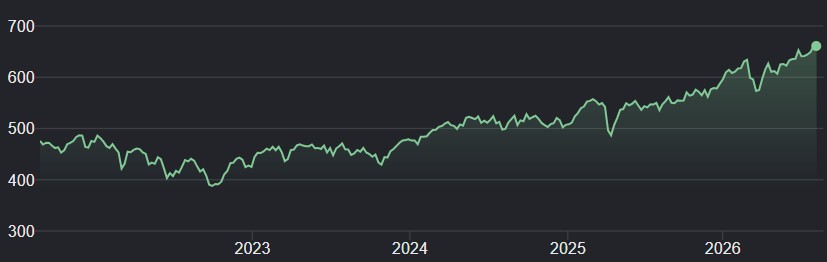
Source: Google Finance*
Technology and AI as the Main Driver
Companies from the technology sector, which were among the best-performing parts of the index, contributed the most to the historically high levels. CNBC pointed out that the five best-performing European stocks this year are linked to the semiconductor sector. These included Soitec, AT&S, Technoprobe, Aixtron and the French-Italian company ST Microelectronics. Their growth shows us that massive investments in artificial intelligence are no longer the domain of the U.S. alone, with investors particularly valuing the large number of orders and, thanks to low supply and high demand, potential future positive results. However, some companies also hit a wall here and fell from their highs after a sharp rise. Such developments show us that despite the importance of the technology sector, expectations are also very high.
Growth Is Not Just About Technology
The strength of European stocks was not based solely on technology, and banks, energy companies and healthcare also delivered strong performances. According to CNBC, the banking sector benefited from a resilient economy, still-strong interest margins and increased activity in financial markets. Energy companies, on the other hand, benefited from higher oil and gas prices, which are linked to tensions in the Middle East. Healthcare was supported by the results of individual companies, such as Denmark's Genmab. Construction also did not lag behind, benefiting from strong demand for data centre construction. A good example is building materials manufacturer Kingspan. However, the earnings season also shows that good figures no longer automatically mean growth in the stock market. For example, the Czech defence company CSG, which weakened on the stock market despite revenues above expectations, or the German insurance division Munich Re. Reuters therefore points out that even though fundamentals remain healthy, higher valuations reduce investors' tolerance for disappointment.
Records Have Not Yet Erased Geopolitical Risks
Behind the record values of European stocks lies an unpleasant paradox. The market is rising despite uncertainty surrounding energy supplies in connection with the Strait of Hormuz, with only a few ships passing through this important transport hub, with the ten-day average standing at just 11 vessels. While higher commodity prices help energy companies, they pose a challenge to the economy – from increasing inflationary pressures and rising costs to complications with the easing of monetary policy. According to analysts, the energy sector remains one of the biggest short-term risks for European stocks. For now, investors are able to overlook geopolitical tensions precisely because of companies' strong financial results.
August Brought Declines
From a historical perspective, it is interesting that the European stock market began August 2026 at record levels. This summer month has a reputation for being a weaker period in Europe, which is why it is associated with the so-called ,,August curse‘‘. It is not fundamentally a bad month; rather, it was the years in which extraordinary events occurred during this month. For example, the EURO STOXX 50 index recorded declines of approximately 9 to 14% in the respective month in 1990, 1997 - 1998, 2011 and 2015*, with the reasons including the financial crisis in Russia, in Asia and the European debt crisis. Another factor may be weaker liquidity during the holiday season, and if a significant piece of news emerges at the same time, price movements may be more pronounced. This year's August is interesting in this context precisely because European stocks are already at record levels and are also facing geopolitical risk, while on the other hand they have a stronger earnings season behind them this time. However, there are still several weeks left until the end of the month, which may bring various events.
* Past performance is not a guarantee of future results.
[1] Forward-looking statements are based on assumptions and current expectations, which may be inaccurate, or on the current economic environment, which may change. Such statements are not a guarantee of future performance. They involve risks and other uncertainties that are difficult to predict. Results may differ materially from those expressed or implied in any forward-looking statements.
This text constitutes marketing communication. It does not constitute any form of investment advice or investment research, nor an offer of any transaction involving a financial instrument. The content of the text does not take into account the individual circumstances of readers, their experience or financial situation. Past performance is not a guarantee or prediction of future results.

.svg)
.svg)