

Nvidia expands its portfolio. Open-source models as a path to success amid Chinese competition?
In mid-December, Nvidia introduced new open-source artificial intelligence models, making them available to a wider audience of users. This represents an important expansion of its strategy beyond closed-source products, for which developers have to pay fees. The large language model Nemotron will be able to handle more demanding computations in a shorter time. The smallest model has been available since mid-month, with additional, larger versions to follow next year. In the fight against rapidly expanding Chinese models, Nvidia also announced the acquisition of SchedMD. The company offers open software solutions for training generative artificial intelligence, including the Slurm technology. SchedMD is not a newcomer—its products are used, for example, by CoreWeave or at the supercomputing center in Barcelona, and it has been cooperating with Nvidia itself for more than a decade. According to Nvidia’s CEO Jensen Huang, access to the giant’s open models is the foundation of progress in AI, and Nemotron additionally transforms advanced AI.
Approval for China
Another piece of good news for the company is a possible change in the rules regarding the export of chips to China. While Chinese companies have so far only been able to acquire weaker versions of the H20 chips, they could now gain access to the more advanced H200. This, however, applies only to certain Chinese companies that have been pre-approved, yet demand remains enormous and exceeds current supply. Among the companies that have already expressed interest are ByteDance, which owns the social network TikTok, and Alibaba. The U.S. president announced this approval on his social network Truth Social, in exchange for a 25% share of revenues from Beijing. Trump justified this step as support for the U.S. labor market and manufacturing. He also pointed out that the change does not apply to the most advanced flagship chips Blackwell and Rubin, which are primarily intended for U.S. companies. It should be added that this step requires approval from authorities in Beijing, which are not very favorable to this transaction because they fear it could slow the growth of domestic companies. Some Republicans also view it negatively due to security concerns.
Controlled Blackwell chips
The rivalry for chip supremacy between the U.S. and China is evident. Chinese versions are somewhat less powerful, which leads to unfair practices. Reuters reported that Nvidia has developed software that allows clients to track the location of chips. According to sources, it should be primarily installed in Blackwell chips. In a statement, Nvidia said that the goal of the software is to maintain control over chip inventory and status. The new software comes at a time when reports have emerged about the smuggling of advanced chips into China. Illegal sales were routed through countries where strict export rules do not apply. In this context, the Chinese company Deep Seek was mentioned, which developed a more advanced product than its American counterparts. According to information from portal The Information, it allegedly used thousands of Blackwell chips.
Once again proving its position
Strong demand for Nvidia’s solutions has been reflected in its financial results for several quarters. The third quarter of fiscal year 2026 once again exceeded expectations and delivered a strong outlook for the near future. Year-on-year, net profit increased by a robust 65% to nearly 32 billion USD, which translates to 1.30 USD per share. Revenues reached 57 billion USD, while LSEG analysts had expected just under 55 billion USD. Data centers remain a strong segment, with revenues exceeding 51 billion USD, with the vast majority coming from sales of graphics processors. The best-selling chip was the second generation Blackwell Ultra. Further growth in chip sales was confirmed by Nvidia’s chief financial officer, following Huang’s October statement that the value of orders through next year will reach 500 billion USD. Nvidia initially rose to prominence thanks to processors for video games, which still generate billions in revenue, increasing by 30% in the monitored quarter. The revenue outlook for the final quarter of 2026 also exceeded LSEG estimates. Nvidia expects revenues to rise to 65 billion USD.
At the peak
Nvidia is also performing well on the stock market, with its shares trading near their historical high, which they reached at the end of October 2025 at 207 USD. Since then, they have slightly declined, closing the trading day on December 16, 2025 at 177.72 USD. From a long-term perspective, the shares remain in positive territory. Over the past year, their price has increased by more than 36%, while over the past five years they have gained a robust more than 1,200%. The company also maintains its leading position in terms of market capitalization. According to Companies Market Cap, it stood at 4.32 trillion USD. At the time when the shares reached their historical high, the company’s value climbed to nearly 5 trillion USD.*
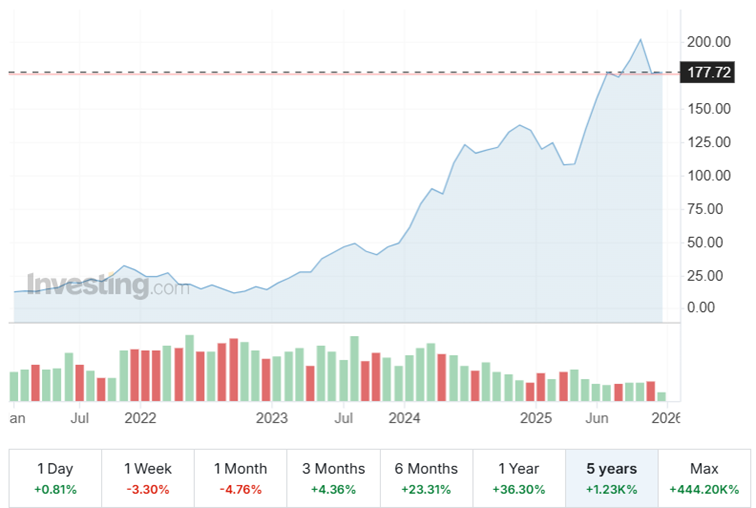
NVIDIA stock performance over 5 years. Source: Investing.com*
*Past performance is not a guarantee of future results.