

Nvidia and Apple Brought Optimism
The semiconductor world is changing rapidly, forcing even major players to respond. News spread globally that Apple and Nvidia are considering Intel as an additional partner, specifically its foundry division. The reasons include geopolitical tensions as well as pressure from the Trump administration to bring manufacturing back to the United States. These reports have not yet been confirmed, but both companies intend to use Intel for the production of less critical chips and components, while continuing to retain TSMC as their primary supplier. For example, Apple would manufacture base processors for the M-series MacBooks at Intel’s facilities. In any case, this represents a shift in the perception of this business division for Intel, which has struggled since its establishment in 2021. Intel is placing significant hopes in its 18A chip, but to succeed it needs to secure a high-quality and reliable customer. Nvidia also tested the chips, but Reuters reported back in December that the company would not proceed further. It will therefore be crucial for Intel to deliver high-quality products in the required volumes.
Unable to Meet Demand
Here, however, a problem may arise. While most of the market is benefiting from enormous demand for artificial intelligence chips, Intel is paradoxically unable to capitalize on it to its advantage. The U.S. company reported quarterly results for the final three months of 2025, with the outlook delivering disappointment. Chief Financial Officer David Zinsner admitted that despite fully utilized manufacturing capacities, they will not be able to satisfy the high demand, meaning deliveries will lag behind. This is compounded by rising prices of memory chips, which is expected to negatively affect the personal computer segment and the latest Panther Lake chip. This outlook goes hand in hand with the revenue forecast for the first quarter of 2026, whose upper bound only narrowly exceeded analysts’ expectations of 12.51 billion USD. Intel forecasts revenues in the range of 11.7 to 12.7 billion USD. Hope may come in the second quarter of 2026, when Zinsner expects an improvement. [1]
Stock Market Volatility
These developments have driven significant stock price movements in recent weeks, in both directions. On January 28, 2026, shares closed the trading day up 11% at 48.78 USD, partially offsetting losses from Friday, January 23. Following the unfavourable outlook, the company’s shares fell by 17% to 45 USD, just one day after reaching a yearly high. However, the sharp decline provided investors with an opportunity to buy at more attractive prices. As of January 30, 2026, the share price stood at 46.47 USD. Despite these sharp fluctuations, the stock recorded a gain of more than 139%, while from a five-year perspective it represented a decline of 20%.*
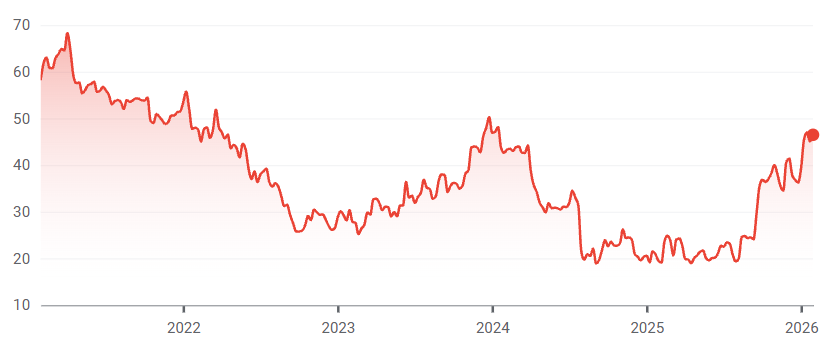
Source: Google Finance*
Financial Results Took a Back Seat
Unfavourable expectations overshadowed solid results that exceeded market estimates. Earnings per share together with revenues reached 0.15 USD and 13.7 billion USD, respectively, surpassing LSEG estimates of 0.08 USD and revenues of 13.4 billion USD. Despite strong sales, revenues still represented a year-on-year decline of 4%. Intel closed the fourth quarter with a substantial loss, which also dampened enthusiasm. The loss amounted to 600 million USD, a significant deepening compared to 2024, when it was “only” 100 million USD. Looking at individual segments, the artificial intelligence and data centre segment performed best, with revenues rising 9% year on year to 4.7 billion USD. Intel’s foundry business also performed well, with revenues climbing to 4.5 billion USD, representing growth of 4%. In contrast, revenues from the division that made Intel famous—chips for personal computers—fell by 7% year on year over the final four months of 2025 to 8.2 billion USD.
Will It Produce Advanced Chips?
When the current CEO, Lip Bu-Tan, took over the company in 2025, he committed to increasing production and pushing Intel to the top position in chip manufacturing ahead of rival TSMC. One of the plans includes producing 14A chips with highly specific technological parameters that will deliver energy-efficient products. However, their high cost could pose a challenge, as producing a single 14A chip costs nearly half a billion USD. This could slow their potential market launch. Market reactions to these ambitions have been mixed. While some view this step optimistically and appreciate investments in ultra-modern products, others remain uncertain and point to high risks and potential mistakes. It appears that 2026 will be an important year for Intel from multiple perspectives.
* Past performance is not a guarantee of future results
[1] Forward-looking statements are based on assumptions and current expectations that may be inaccurate, or on the current economic environment, which may change. Such statements are not a guarantee of future performance. They involve risks and other uncertainties that are difficult to predict. Actual results may differ materially from those expressed or implied by any forward-looking statements.



.svg)
.svg)