
Apple as we know it today is synonymous with stability, although the 1990s told a very different story. By the end of the decade, the company was struggling with a sharp decline in revenue, reporting a loss of more than 1 billion USD in 1997. During this period, its founder Steve Jobs returned and implemented necessary changes, including streamlining the product portfolio, eliminating loss-making projects, and establishing a clearer strategic direction. Interestingly, many of Jobs’ principles are still in use today and formed the foundation of the company’s later success.
What is the real product?
Apple is primarily associated with the iPhone, which generates a significant portion of its revenue. However, the company’s real competitive advantage lies in its closed ecosystem. Apple began shaping this model during the era of iPods and iTunes, which first connected hardware, software, and services. This was followed by the launch of iPhones and other devices, along with the creation of the App Store, opening up a new revenue stream. Notably, Apple reports having more than 2.5 billion active devices globally. This success creates room for better monetization and stable income, making services another key growth engine in recent years. This approach also explains why customers rarely switch to other brands what would mean losing convenience, compatibility, and content. From a financial perspective, this represents an exceptionally strong business model, as it ensures recurring revenue. Thanks to this, Apple has transformed one-time product sales into a “long-term relationship” with customers.
Company growth
Apple has evolved from a volatile tech stock into a stable company thanks to its ability to generate high financial volumes across economic cycles. In the first quarter of fiscal year 2026, Apple reported revenue of 143.8 billion USD, representing approximately 16% year-over-year growth, exceeding expectations of 138 billion USD. Net profit reached 42 billion USD, up from 36 billion USD the previous year. Revenue from iPhone sales alone exceeded 85 billion USD, followed by services revenue of 30 billion USD. Strong and consistently growing financial results enable the company to conduct share buybacks and pay regular dividends. In the next three-month period, the company expects revenue to grow by another 14% to 16%. [1]
Strong market performance
Apple’s stock market performance is also noteworthy. Since its early days in 1986, its share price has increased by five-digit percentages. Over the years, the company has experienced periods of correction, yet its shares maintained an upward trajectory, reaching an all-time high of 278 USD in early December 2025. Although the price declined by about 4% to 259 USD from the beginning of 2026, it rose by 30% over the past year and by as much as 95% over five years. Recent market declines caused Apple to slip slightly in the ranking of the world’s most valuable companies by market capitalization, but it still held 3rd place, closely behind Google. The company’s valuation exceeded 3.82 trillion USD (as of April 9, 2026).*
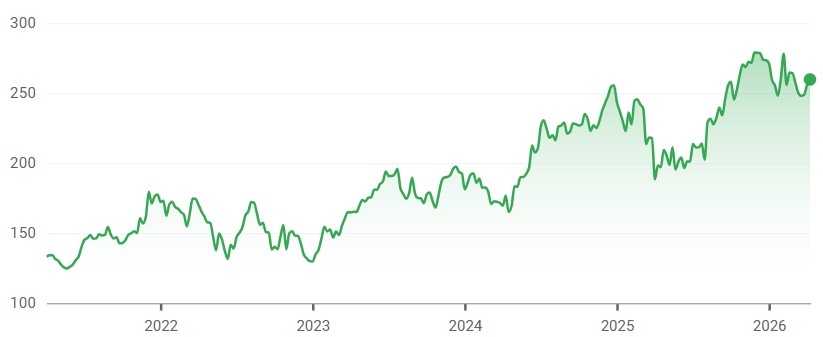
Source: Google Finance*
Stability as the new strategy
Under the leadership of Tim Cook, who took over shortly before Steve Jobs’ death, Apple has transformed into an efficient enterprise. However, this does not mean it has stopped innovating and it continues to invest in technologies including artificial intelligence and new devices such as a forthcoming foldable iPhone. Nevertheless, the pace of major innovations has slowed, and the company is now more focused on optimization. Apple also faces new challenges, including increasing regulatory pressure, particularly in the App Store and digital services, as well as the need to respond to geopolitical risks and diversify its supply chains. Investors are closely watching how Apple approaches the artificial intelligence revolution. The question remains whether the company can deliver another market-changing product like the iPhone. While Apple stands at the top today, it also faces new competition and high expectations.
* Past performance is not a guarantee of future results.
[1] Forward-looking statements are based on assumptions and current expectations that may prove inaccurate or change due to economic conditions. Such statements are not guarantees of future performance and involve risks and uncertainties that are difficult to predict. Actual results may differ materially from those expressed or implied in any forward-looking statements.


.svg)
.svg)