


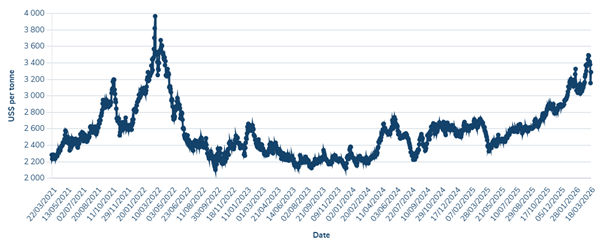
Aluminium on the London Metal Exchange (LME) has experienced volatility in recent days, with the end of the week bringing a rise to multi-year highs, after which its price dropped sharply. Following concerns about supply disruptions due to the conflict in the Persian Gulf, the price of 3-month contracts rose above 3 500 USD per ton on March 19, 2026, representing the highest level in the past four years. Stability was disrupted by a sharp correction due to concerns about a global slowdown and high oil prices, which are also reflected in metal consumption. The psychological factor also played a role, as investors began closing their positions after the rise. At one point, the metal’s price fell by 8%; by March 20, losses slightly decreased and contracts closed at 3 287 USD.*
Source: London Metal Exchange*
Supplies under pressure
The Persian Gulf region is a key producer of aluminium, so the situation there is the most important factor affecting the market for this metal. Reuters reports that about 9% of global production comes from this region, and if we exclude Russia and China from the equation, the percentage increases significantly. The conflict led to the closure or restriction of some smelters. An important link is one of the most crucial transport routes, the Strait of Hormuz, through which a large portion of global trade passes. Exports and supplies of input materials are being disrupted, which ultimately leads to a situation where there is willingness to supply, but logistical constraints do not allow it. Interestingly, the impact of the conflict is not only reflected in the physical availability of the metal but also in price premiums. European and Asian exchanges recorded a significant increase in premiums above market prices, signalling an acute shortage of immediately available material, with these premiums reaching their highest levels in recent years. However, the conflict has not only brought price increases. Yahoo Finance states that higher prices and uncertainty have also weakened demand in some regions, which is typical for markets during geopolitical instability, when buyers are more cautious in their purchases.
Overstocked Chinese warehouses
This phenomenon is important in China, which plays a specific role in the aluminium market. The country usually acts as a stabilizing element, but the situation is currently evolving differently, as aluminium inventories have begun to accumulate there according to Yahoo Finance, with volumes reaching the highest levels since 2020. Interestingly, despite the global shortage, China is struggling to find local buyers for its inventories. As for exports abroad, they increased by about 13% in the first months of 2026. An important factor is that Chinese production is reaching its limits. Capacity constraints and regulatory interventions mean that the country can no longer respond to supply disruptions as it did in the past. This is also confirmed by Reuters analyses, according to which the Chinese sector is operating close to maximum capacity. This in some cases contributes to imbalance by exporting surplus during periods of weak demand.
Shortage for data centres
On the other hand, we have another industrial metal, copper. In recent years, it has come to the forefront mainly due to growing demand from the technology sector. According to the latest reports, the risk of a copper shortage is increasingly evident, linked to the expansion of data centres. These facilities are extremely demanding in terms of electrical infrastructure, including extensive cabling, which automatically increases copper consumption. Demand for data centres is growing mainly in connection with the development of artificial intelligence and cloud services. However, supply is not keeping pace with this growth. Copper mining is capital-intensive and new projects require years of preparation. This means that in the short term it is not possible to significantly increase production. Therefore, it is increasingly being said that a shortage of copper may slow down the development of technological infrastructure.
Correction also hit copper
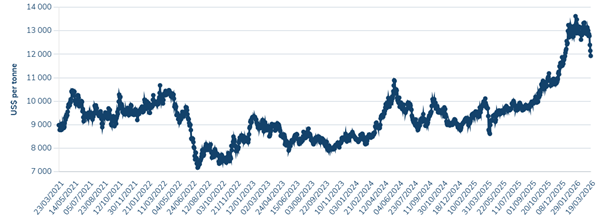
The development of copper prices in recent periods shows its sensitivity to global economic factors. The red metal has recently gone through the same development as aluminium. The beginning of the year was marked by record levels, driven by strong demand and limited supply. The last days of January brought the price just below 14 thousand USD per ton. In recent days, however, the price has changed significantly. Copper joined the broader sell-off, also due to fears of a slowdown and position closing. An important factor was the latest decision of the US Federal Reserve, after which several assets weakened, including gold, silver, and cryptocurrencies. At its second meeting this year, the Fed decided to keep interest rates unchanged at 3.50 – 3.75%. As of March 20, the price of 3-month copper futures fell by about 10% to 11 929 USD.* Despite the short-term decline, long-term fundamentals remain relatively strong thanks to the aforementioned demand from energy, electromobility, and digitalization.
Source: London Metal Exchange*
* Past performance is not a guarantee of future results.



.svg)
.svg)